
Trusting a Bum Ankle To Simms’ Access Wading Boot

Ninety percent of the time I don’t need a beefy, ridged, behemoth of a wading boot that would work just as well on Mars as it would while wading the Madison.
Don’t get me wrong; I’ve packed superbly constructed, super rigid, and very heavy boots all the way from Montana to Russia and back . . . because I didn’t want any type of failure, nor the possibility of turning an ankle, when I’d already invested so much time and effort to reach the Kola. But again, an overbuilt boot is ridged, heavy, cumbersome, and requires a long dry time (important when traveling and weight matters).
Still, I was a little skeptical when Simms sent me a pair of lightweight Access wading boots this past spring with the marketing promise that “this boot offers unmatched stability, unparalleled grip, and next-level comfort.”
I’ll give them two of those three, the outlier being unparalleled grip. See, I’ve been fishing long enough to remember when rubber soles first hit the market and every company that attached them to their wading boots claimed rubber was stickier than felt. I am still surprised that none of the manufacturers were sued for false advertising or that someone didn’t drown and have their family take up legal arms against those “sticky” promises. I still think felt (especially with studs and where allowed) is superior to “sticky rubber” but there’s no denying the convenience and longevity of rubber soles, especially when paired with aluminum studs.
Simms’ Access boots, which weigh 45 ounces each and cost a cool $300, sort of provide the best of both worlds, a combination of what made Simms’ 42-ounce Flyweight boots so popular, with added durability.
The Flyweight boots ($149.98) utilize a full Idrogrip Flex sole that does, somehow, feel spongy and similar to felt. It’s definitely “stickier” than hard rubber, but that sole wears faster than Simms’ other offerings, an issue that the Access boot remedies. How so? The Access boot uses that same sticky Idrogrip on the middle of the sole and surrounds it with about two inches of harder, more durable Vibram IdroGrip as the outsole. Importantly, the Access’ outsole is set up for eight studs or cleats which, when utilized, offers excellent grip, even on slick, moss covered rocks.
I’m a guy who likes a level of solitude with my fishing, so I look for a great traction solution, minus unnecessary weight. After a season of use I can’t find one thing wrong with the Access boots. They held up perfectly to abrasion, even while scraping my way around Rock Creek, the Blackfoot, the Clark Fork and Bitterroot, and Idaho’s notoriously slick Lochsa River. And, they haven’t let me down on the trail when hiking in for some off-the-grid bull trout and cutthroat. I wouldn't hesitate to wear these boots on the Dean, the Clearwater or in southeast Alaskai where the words "remote steelhead" take on new meaning and one bad slip could end a trip.
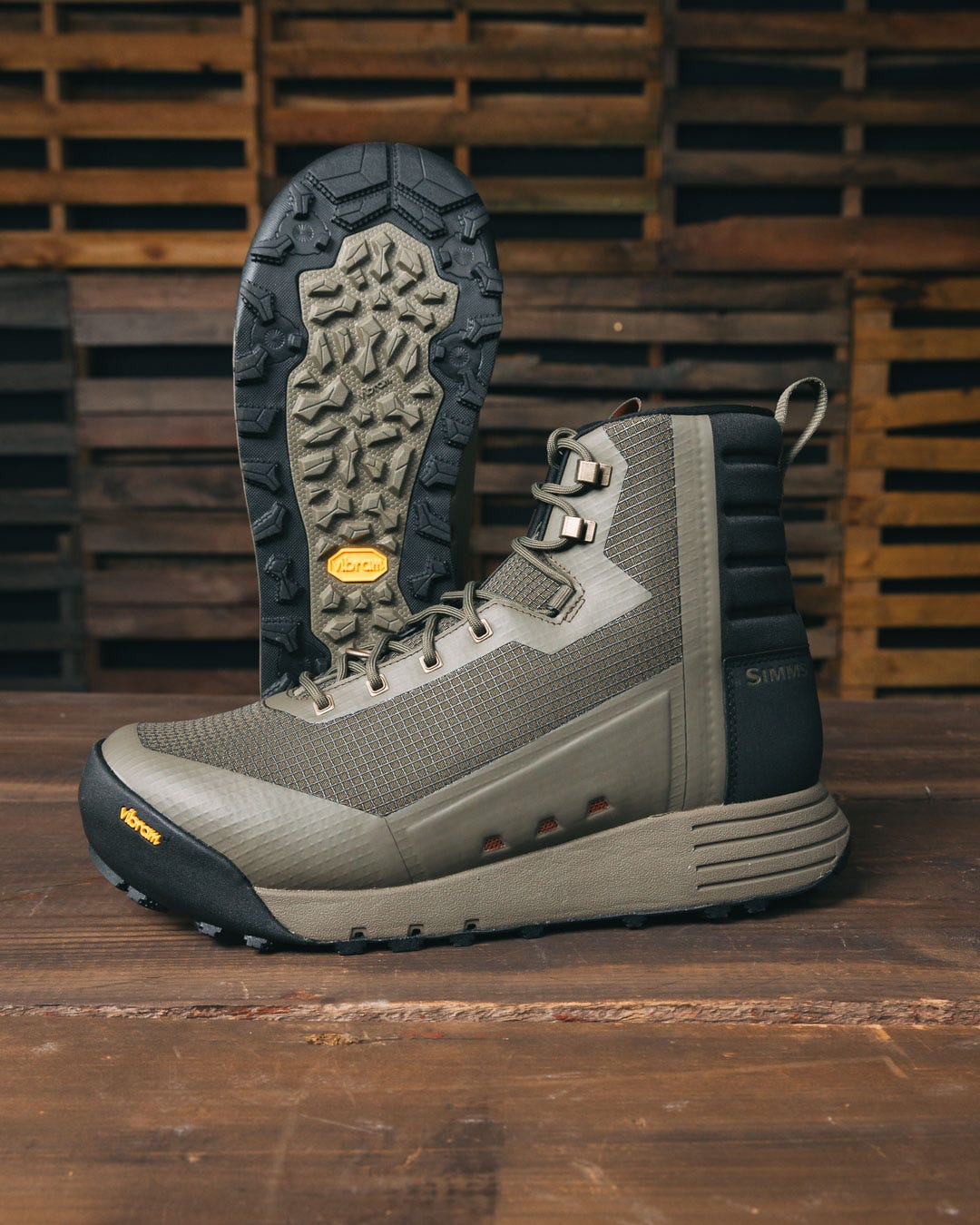
One downfall to lightweight wading boots, no matter the brand, is that stability is often sacrificed when weight decreases. That’s a deal-killer for me: I completely blew out my ankle in 1986 and have dealt with instability ever since. It could be dangerous to twist that ankle or, god help me, dislocated it again in the backcountry. So, I always consider stability as priority one in a boot. The Access boot isn’t built like Simms’ ridged G4 boot, but it ‘aint no slouch. A rigid heel cup and semi-stiff but flexible upper offer all I need.
The boot has TPU overlays (marketing speak to say it’s abrasion resistant while maintaining flexibility) which extends overall life. Really, what you get in the Access is a lightweight out-of-the-box immediately wearable boot that grips slippery rocks, performs well on the trail, and should last many seasons, depending on how often you fish
When Simms offered this boot for testing, I requested a size 11.5 boot and received an 11. Not the end of the world but I knew I’d be compromised by wearing stocking foot waders in tandem with these boots. So, I simply used them for wet wading, with a wading sock, and the fit was just fine. So, if you only plan to use these when wet wading with a heavy-ish sock, maybe go down a half size. Wearing them with stockingfoot waders? Go true-to size.
If you like hiking to untouched waters, and appreciate light weight with durability, stability, and great grip, the Access boots make total sense.
If you're ready to buy, click HERE.