Are LOC Waders Worth the Price? An Honest Review.

Words by Darren Wood
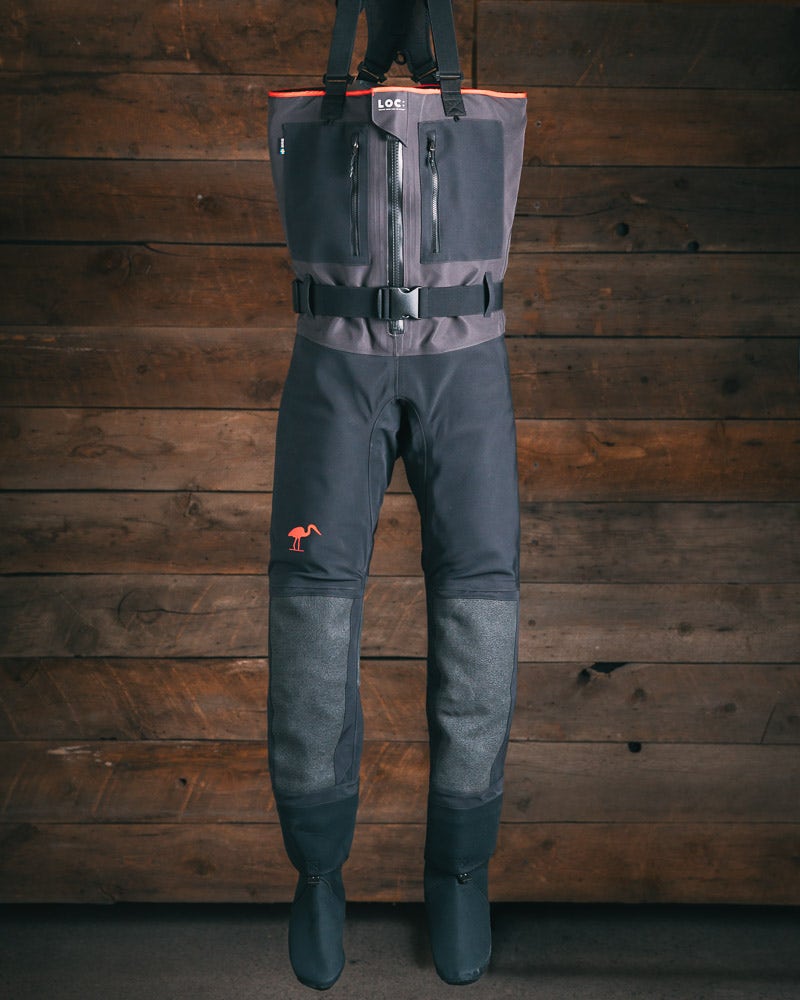
In June my friend and coworker, Jay D’Arpini, and I were invited to Norway by Lars Litzell and Christer Andersson for the opening of Atlantic salmon season on the Orkla River. Lars and Christer are the founders of LOC Waders and provided an opportunity to field test the LOC 3D Mesh Tech Wader in a very demanding environment. This unique wading system comes standard with a breathable mesh liner and durable membrane – the same material used in scuba dry suits utilized by militaries and rescue teams throughout the world.
This was the first time Jay and I had been to Norway and the first time we’d heard the phrase “fishing the beat.” Typically, in Norway, a river “beat” is understood as a single run or pool shared by a group of half-a-dozen to a dozen anglers - each taking a turn stepping down the run. We fished a special beat – the birthplace of LOC Waders – and shared six runs among a small group of anglers, fishing hard for six days.

Prior to the trip, Christer said we would be grinding, and grind we did. Early in the season, chances of catching an Atlantic can be slim, but if the stars aligned any of us could have wound up with a 40-pound giant on the end of our line. This region is known for its unpredictable river flows, chilly temperatures, and frequent rain – all conditions that tested our gear and our patience.
Out of all the runs my favorite was Sand-Holen, a dogleg right with a short scramble over boulders ending in a sandy river bottom – hence the name. It wasn’t long before I put my pair of LOC Waders to the test – sliding down rocky, thorny riverbanks, crawling over boulders, beating through the brush, and wading through ever-changing water conditions. I often kneeled on rocks for balance, which put the wader’s surprisingly grippy, Kevlar-enforced knees to the test. Beyond fishing, I wore these waders while performing camp chores, such as gathering firewood, snapping sticks over a knee for kindling, etc.
DID LARS JUST SACRIFICE HIS WADERS TO PROVE A POINT?
One evening, while discussing the waders over dinner, Lars demonstrated just how strong the Kevlar-enforced knees are. He grabbed a chef knife from the counter and began slicing at the knee of his nine-year-old LOC prototypes. My immediate thought was, “Did Lars just sacrifice his waders to prove a point?” Surprisingly, after several slices to the knee, there wasn’t a single scratch on them.

Kevlar Enforced Knee Panels Unique to LOC Waders
As the everchanging weather shed rain and high mountain snowmelt to the river, Sand-Holen became a different place. The spots along the run once comfortable to cast from now proved difficult. My sure-footed confidence was replaced with clumsiness as I felt around with my legs, knees and boots, trying to detect submerged boulders that used to be above water. One bad step had me falling backwards, and to protect my rod I lifted it in the air and took a seat on the river bottom. Water rushed into my waders, an unwarranted cold plunge. Lars and Christer saw me go down and they rushed over, each making sure I was ok, but also chuckling at my misfortune. Nobody wants to take a swim while fishing, but on the bright side it was a perfect opportunity to see how quickly the liner dries out. Over the following 15 to 20 minutes or so, I removed the mesh liner, hung it out to dry, and sat near the fire in my merino wool long underwear. While I warmed up, the landowner swung by camp to empty trash and see how the fishing was. By the time he left, the mesh liner was dry. However, my merino wool was still damp. Time was of the essence, so I put the liner back in my waders and went back to the top of the run. Though damp to start, I stayed warm throughout the rest of the day. Lesson learned – always make room for a spare pair of long underwear.

Cold Plunge Aftermath. - Photo by Christer Andersson
Temperatures during the trip hovered between 40–70°F (4–21°C), and with a thin merino wool baselayer under my waders, I stayed plenty warm. On wetter, colder days, I layered with a Norlender wool sweater (when in Norway) and a rain shell. When the sun came out and temps hit the mid-60’s to 70’s (15-21°C), I dressed down in a cotton T-shirt but kept wearing those merino bottoms. When I got warm, I could take a quick, waist-deep dip in the river and the wader’s membrane and mesh seemed to hold that cool temp.
It's marketed that LOC Waders don’t breathe and that is true regarding the membrane or the outside of the wader. But, what sets these waders apart is the mesh liner inside. The liner regulates your body temp, wicks moisture away from the skin, and stashes it on the inside of the membrane. Technically, the mesh liner does all the breathing, and it works surprisingly well. You just have to turn the wader inside out to dry if you wear them for long periods of time. Not only did the mesh keep me dry while chasing salmon on the Orkla, but it also acted as an all-around cushion, providing comfort while kneeling, sitting, and leaning against uneven surfaces. After a full day in the elements, wading chest-deep in cold water, and dealing with steady rain, I stayed dry, comfortable, and free from that sweaty, clammy feeling I get while wearing other waders.
I wore my waders 12 hours a day, taking breaks to eat lunch and dinner, and only took them off at the lodge. Turning them inside out allowed for any condensation collected on the inside of the membrane to dissipate. After a short night of sleep, I was back in the waders for another 12-hour day of swinging runs.
The grind continued. Breakfast. Swing. Lunch. Swing. Dinner. Swing. Sleep. The mental games came into play, and I began to question everything. Did I swing that run efficiently? Are there even fish in this river? Are the salmon running yet? How many more swings until they arrive? Just as the thought of taking a break would cross my mind, the idea of it all coming together on my next swing replaced it. I was in an anadromous paradox.

Cast. Swing. Repeat. - Photo by Christer Andersson
Some people often ask, “Why fish for a species that is so difficult to catch?” I’ve heard many seasoned Spey anglers answer the question the same way – it only takes one. After fishless days on the Orkla my patience was running thin. Then I saw signs of life rolling through the run. As I cast out and waited for my fly to complete a swing, I looked over my left shoulder and made eye contact with an Atlantic salmon that rolled on the surface while powering through a rapid. With instant recall, I heard Lars saying, “If you see the fish, run back up and fish your fly in front of him. He will eat.” With 100 percent confidence in catching that fish, I reeled in and took off, quickly scrambling over rocks to the top of the run. With excitement I waded in and tried to cover the water efficiently. I came up empty-handed, but the memory of that fish rolling past remains vivid.
Although my timeline is warped, on either day three or four Christer finally hooked into a fish. Jay and I heard a cry from down-river, grabbed our camera gear, and ran. Spirits were high as Jay tailed the fish, a healthy sea trout. Christer was laughing as he relived the catch. He had rested his rod beneath his arm and unzipped his waders to use the facilities, so to speak. As he looked around, finishing business, the drag on his reel began to engage. He’d assumed his fly was stuck on bottom and the current was taking out line. On the retrieve, and to his surprise, he came tight to a fish. I’ve witnessed people catching fish in peculiar ways, but this was one for the record books. This is why we fish for a species so difficult to catch. It’s the small victories, often when we least expect it, that motivates us to keep going. Christer’s fish gave us a much-needed boost of hope and hope can breed success.

Christer's Substantial Sea Trout
After celebrating Christer’s catch, we kept grinding, fixed on the goal of catching an Atlantic. Christer headed downstream to the lowest beat. Jay, Lars, and I stayed at Sand-Holen. Several hours of casting produced no fish, but Lar’s phone began to ring. It was Christer. Jay and I stood by listening to the Swedish banter, wondering what was being said. Lars looked up at us and said, “Fish On!” A split second after the words left his mouth Jay and Lars we’re tearing down the road, Spey rods bouncing off the roof of the truck. They got to the beat just in time and Lars tailed the fish, a 15-pound (7kg) salmon. Jay stood near, camera in hand, and captured the moment. We had begun to think that getting a fish on the Orkla wouldn’t happen, but thanks to Christer’s good fortune, we got two, one being a River Orkla ghost.

Hard Work Pays Off, Sometimes in the Form of an Atlantic Salmon.
We didn’t catch many fish on this trip, but we enjoyed a sense of comradery between anglers. Everyone fished with a common goal, wearing the same waders, and sharing stories and experiences over the same meals. It was quality time with quality people in quality waders. During my week on the Orkla I become a believer in LOC Waders and the company’s efforts to create the best wader in the world. Christer and Lars have built something truly different, backed by their passion for chasing anadromous species. But one question remains…
Why should someone pay $1,650 for a pair of waders?
As Christer answered, “Our brand promise is like no other. Our waders are handmade by real people. Not to be compared to industrial made waders where the driving force is speed and volume. When speed and streamlined processes become the driving force, one will always compromise on quality. We decided to use the toughest materials and components out there, which comes at a price. This is one of the reasons our waders are more expensive than ordinary waders. It’s also the reason they are more durable. Our first prototype is going on nine seasons.”
LOC Waders come with an unrivaled, three-year worldwide warranty against material and/or manufacturing defects, limited to the original purchaser. They also have a 90-day leak reassurance. If your waders leak during the first 90 days of ownership, due to manufacturing or material faults, LOC will either replace your waders with a new pair in the same size you originally purchased or they will repair them at no cost, depending on the fault. Click here for more details regarding the warranty.
In my mind you buy the best gear you can afford and don’t leave anything to chance. In certain travel situations, gear can be so critical to the success of a trip that the consequences of failure are simply too high. Warranties don’t do much good if a product fails in the field. Assurance beats insurance every time. Those were the stakes during our trip to the Orkla. Gear failures could have cost us time in a situation where every single cast counts. I can’t tell you if an Atlantic salmon ever came up to sniff my swung fly, but I can say that those LOC Waders allowed me to be on the water every second possible and gave me the best shot at getting a tug in the Land of The Midnight Sun.